
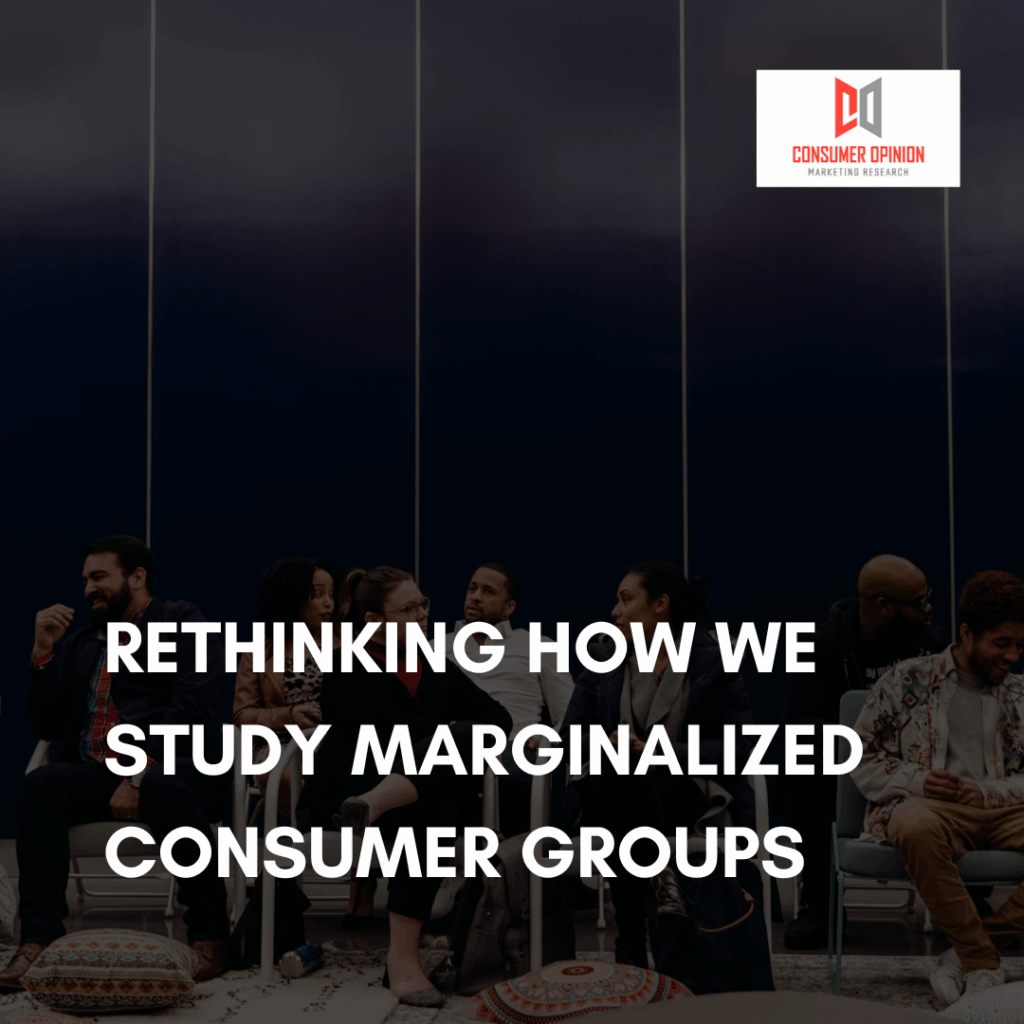
Studying marginalized consumer groups isn’t just an expansion of sample diversity, it requires a rethinking of how research is designed, conducted, and interpreted. These groups often navigate markets under different constraints, histories, and cultural meanings, so understanding them demands more than just inclusion. It demands care, flexibility, and an awareness of power. Here are four principles, each explored in depth, to guide responsible and accurate research with marginalized consumers.
1. Representation Must Be Intentional, Not Symbolic
Representation begins long before data collection, it starts in the way we define who counts as a “consumer” worthy of study. Many marginalized groups get excluded due to rigid screeners, standard recruitment channels, or assumptions about “market relevance.” Intentional representation means examining these barriers honestly. Partnering with community organizations, using on-ground networks, and designing recruitment criteria that reflect lived experiences rather than demographic checkboxes ensures that participants are not just “included” but genuinely present in the research.
Symbolic inclusion, where a few participants from marginalized groups are sprinkled into a sample, often results in superficial insights. It may satisfy a diversity requirement, but it does not create depth. To avoid this, researchers must build participants’ comfort, trust, and willingness to engage meaningfully. Adequate compensation, flexibility in scheduling, and supportive participation environments signal that their contributions matter. Without these considerations, representation becomes a box-ticking exercise rather than an ethical commitment to hearing real stories.
2. Context Shapes Expression, So Methods Must Adapt
Marginalized participants often communicate differently across formal and informal settings. Standard research environments, conference rooms, controlled labs, central-location focus groups, may unintentionally suppress their authentic voices. When participants perceive the setting as intimidating, unfamiliar, or “official,” they may say what feels socially acceptable rather than what is true. Adapting methods to participants’ contexts ensures that their expressions are not filtered by discomfort or power distance.
This adaptation may include conducting interviews in homes, community spaces, or familiar neighborhoods; offering multiple languages or dialects; using photographs, voice notes, or loosely structured conversations instead of tightly scripted tools. It also means letting participants set the emotional and conversational tempo rather than enforcing formal discussion norms. When research methods bend toward people’s realities, rather than forcing people to bend toward the method, insights naturally become richer, more nuanced, and more reflective of lived experience.
3. Power Dynamics Influence What Is Said and What Is Withheld
In any research encounter, power is present, economic power, linguistic power, educational power, institutional power. With marginalized groups, these dynamics are amplified. Participants may see researchers as authority figures, and this can shape their willingness to share negative experiences, criticisms, or vulnerabilities. Acknowledging this isn’t a weakness; it’s a necessary part of designing ethical research. Clear, compassionate consent processes and non-judgmental interviewing techniques can reduce the pressure participants feel to perform or impress.
Reflexivity, the researcher’s awareness of their own biases, assumptions, and social position, is crucial. Researchers must ask themselves: How might who I am shape what this person is willing to say? When power dynamics are recognized and intentionally softened, people feel safer to express dissent, complexity, and emotional truth. This leads to data that is not only ethically gathered but also more accurate. Ignoring power results in shallow insights; addressing it produces depth.
4. Interpretation Must Avoid Stereotypes and Structural Blind Spots
Marginalized groups are often interpreted through oversimplified narratives: “price-sensitive,” “traditional,” “uninformed,” “risk-averse.” These interpretations, though common, are rarely rooted in context. They reduce complex realities to stereotypes and place responsibility on individuals rather than systems. Responsible interpretation involves connecting behaviors to structural constraints, access, mobility, stigma, discrimination, safety, availability, instead of attributing them to immutable characteristics.
A deeper layer of interpretation also looks for variation within groups. No marginalized community is homogenous. Differences in age, gender, ability, caste, religion, neighborhood, or life-stage can dramatically shape consumer behavior. Moreover, marginalized consumers often exhibit creativity and resilience in navigating constraints; highlighting these strengths shifts the narrative from deficit to agency. When researchers interpret through a structural and strengths-based lens, the insights that emerge are more accurate, actionable, and respectful.
Conclusion
Studying marginalized consumer groups requires more than methodological competence, it requires humility, adaptability, and ethical commitment. Intentional representation ensures voices are genuinely present, method adaptation ensures they are heard authentically, attention to power ensures they are safe to speak, and thoughtful interpretation ensures they are understood accurately. When research honors these principles, it not only produces better insights but helps shape markets that are fairer, more inclusive, and more humane.